Motivation shapes not only whether we act, but also how much effort we are willing to invest and how long we persist. Across brain disorders—including depression, schizophrenia, Parkinson’s disease, and Alzheimer’s disease—reduced motivation can manifest as diminished initiative and effort, disrupting everyday life in ways that cannot be explained simply by low mood, cognitive decline, or slowed movement. Understanding how the brain organizes goal-directed action and sustains effort—and why these processes break down—is therefore an important step toward promoting functional recovery in brain disorders.
Chronic pain offers a window into these processes. Persistent pain can cause sensory abnormalities while gradually reducing the willingness to work for reward, yet these changes do not always emerge together. Much previous research has focused on emotional and motivational disturbances after chronic pain is established, with less attention to how these disturbances develop. How do prolonged adverse experiences reshape the neural circuits that support action, and how does early neural activity influence motivation later on? Answering these questions could help explain how motivational decline develops and guide the choice of intervention targets and timing, extending treatment goals beyond sensory relief to restoring the capacity for sustained action.
On October 9, 2026, a team led by Professor Wei-Guang Li at the Institute for Translational Brain Research (ITBR), Fudan University, together with teams led by Drs. Lu Song and Zhenguo Liu at Xinhua Hospital, Shanghai Jiao Tong University School of Medicine, published a study online in Neuron entitled “Stepwise engagement of cingulate ensembles underlies motivational decline in chronic pain.” The study shows that sensory hypersensitivity and motivational decline after nerve injury involve the stage-dependent engagement of distinct neuronal ensembles in the anterior cingulate cortex (ACC). The effects of pathway-specific interventions also depend on the stage at which they are initiated, providing new circuit-level insight into how sensory and motivational symptoms evolve during chronic pain.
The ACC contributes to pain processing, cost–benefit evaluation, and goal-directed behavior. Using a mouse model of neuropathic pain, the team combined longitudinal behavioral assessments, neuronal ensemble tagging, in vivo recordings, and circuit-specific interventions to investigate how sensory abnormalities and impaired sustained effort develop. The researchers assessed sustained effort using a progressive-ratio (PR) task, in which mice earned food rewards by nosepoking a touchscreen. Each successive reward required progressively more nosepokes. Compared with sham-operated controls, mice with nerve injury showed sensory hypersensitivity by postoperative day 1. Clear reductions in effort-related measures, including rewards earned, were detected during testing on days 7–9 and remained evident on days 14–16. This temporal separation suggests that motivational decline cannot be explained simply by pain’s immediate suppression of behavior.
Guided by this timeline, the researchers used activity-dependent tagging to compare neuronal ensembles engaged at different stages. Whole-brain activity mapping revealed prominent early changes in the basolateral amygdala (BLA) and thalamic regions, whereas later changes involved the ACC and lateral habenula (LHb), among other areas. Within the ACC, early-tagged ensembles showed a projection bias toward the BLA, while later-tagged ensembles favored the LHb. These two projection-defined populations showed little overlap and distinct stage-dependent changes in activity.
In vivo recordings further showed that the two pathways carried different behavior-related information. After nerve injury, ACC→BLA neurons responded more strongly to light touch, whereas the relationship between ACC→LHb activity and the progression of effortful behavior weakened markedly. Single-unit recordings revealed that some ACC→LHb neurons fired in relation to momentary nosepoke responses, while others exhibited activity that changed more slowly over the course of the task. Following injury, persistence-related coding was substantially disrupted, while some immediate action-related responses were retained. Task-related information also remained detectable in nucleus accumbens dopamine signals, indicating that impaired persistence can coexist with reward-related responses.
Do these pathways directly contribute to the behavioral changes? The researchers used closed-loop optogenetics, with each nosepoke triggering 1 second of inhibition of ACC→LHb neurons. Mice with nerve injury earned more rewards, although their sensory hypersensitivity was unchanged. Inhibiting this pathway repeatedly over several days also improved effortful responding. Interventions targeting ACC→BLA showed a different, timing-dependent pattern. Repeated inhibition beginning on the day of nerve injury reduced both sensory hypersensitivity and the later decline in effortful responding. When inhibition was delayed until day 4 after injury, it reduced sensory hypersensitivity but did not significantly improve later effortful responding. These findings suggest that early pathway activity may influence subsequent behavior as well as contribute to the sensory abnormalities present at that stage.
To identify the circuit basis for these effects across time, the researchers examined upstream inputs and connections between the pathways. Input from the anteromedial thalamic nucleus (AM) preferentially targeted ACC→BLA neurons. Inhibiting this AM-recipient population from the day of injury also reduced sensory hypersensitivity and improved later effortful responding. The team further identified recurrent connections between the ACC and BLA. BLA projections back to the ACC could influence multiple ACC output populations, including ACC→LHb neurons. Activating this BLA→ACC return projection while inhibiting the ACC→BLA pathway counteracted the improvements in sensory hypersensitivity and effortful responding. These results suggest that recurrent ACC–BLA–ACC signaling may provide a route linking early pain-related activity to later motivational impairment (Figure 1).
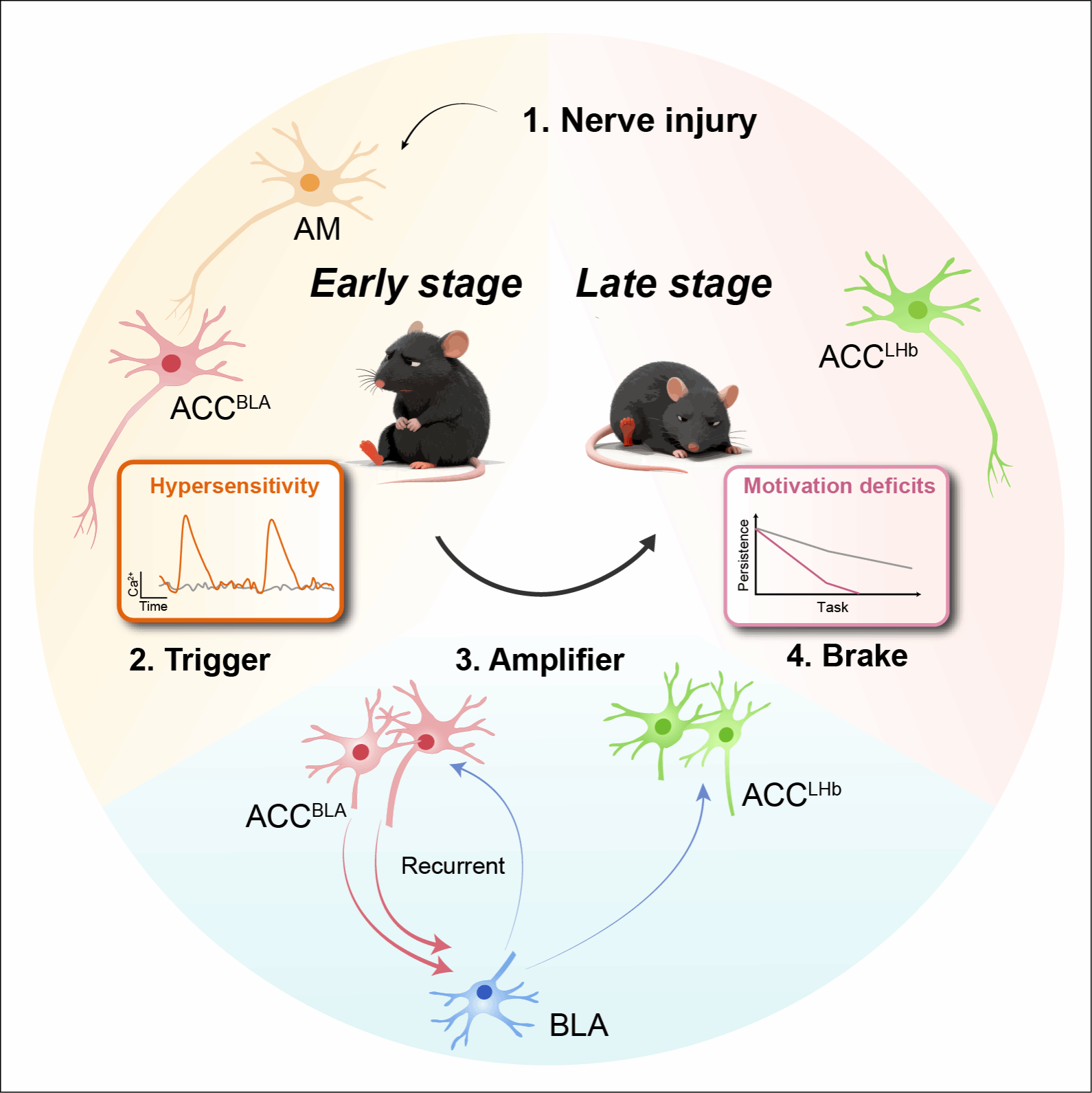
Figure 1 Working model illustrating how stage-dependent engagement of anterior cingulate circuits contributes to motivational decline in chronic pain
By following the course of neuropathic pain, this study identifies distinct contributions of neuronal ensembles to sensory hypersensitivity and motivational decline and clarifies their temporal relationship. Later motivational impairment may reflect not only ongoing pathway activity but also the influence of earlier pain-related activity. The findings thus offer circuit-level clues to how prolonged adverse experiences progressively alter behavior. The disruption of persistence-related coding alongside the retention of some immediate action-related responses also helps distinguish which components of motivated behavior are affected.
The work builds on Professor Li’s long-standing research focus on “how experience gives rise to memory and how memory shapes behavior.” His team studies neuronal ensembles and their connections to understand the lasting effects of experience on subsequent behavior. This study extends that approach to motivational changes during persistent pain, tracing how behavioral impairments emerge to identify potential intervention targets and windows.
From an intervention perspective, reducing sensory hypersensitivity and restoring sustained effort do not necessarily occur together and may require targeting different pathways at different stages. These animal findings provide a basis for exploring strategies that address both pain relief and motivational recovery. They also highlight the importance of assessing participation in activities and everyday functioning alongside sensory symptoms when evaluating interventions. Comparing the circuits involved in effort investment and sustained action—and how they change over the course of different disorders—may help distinguish shared processes underlying motivational decline from disease-specific mechanisms and identify more specific avenues for promoting functional recovery.
Wenying Xu, a former postdoctoral researcher at ITBR, Fudan University, and Jiu-Yang Sun, a doctoral student at Xinhua Hospital, Shanghai Jiao Tong University School of Medicine, are the co-first authors. Professor Wei-Guang Li of ITBR and Drs. Lu Song and Zhenguo Liu, chief physicians at Xinhua Hospital, are the co-corresponding authors.
The study was supported by China’s Science and Technology Innovation 2030 Major Project on Brain Science and Brain-Inspired Intelligence, the National Natural Science Foundation of China, and research funding programs in Shanghai, among other sources. The work also benefited from collaborations with Dr. Junfa Wu, Deputy Director of the Department of Rehabilitation Medicine at Huashan Hospital, Fudan University; Dr. Bomin Sun of Ruijin Hospital, Shanghai Jiao Tong University School of Medicine; and Professor Tian-Le Xu of Shanghai Jiao Tong University School of Medicine.
Article link: https://doi.org/10.1016/j.neuron.2026.09.018








 Address:No.138, medical college road
  Postcode:200032
  Tel/Fax:021-54237056
 Emial:itbr@fudan.edu.cn