疼痛是一种令人不快的感官与情感体验,常伴随负面情绪状态的产生[1-3]。疼痛及其后续情绪状态均受到生物、心理与社会因素复杂交织的深刻影响[4]。既往研究表明,源自积极社交互动的社会奖赏与多巴胺、内源性阿片类等神经化学物质的释放相关,而这些物质能降低疼痛敏感性并提升幸福感[1,3,5]。相反,负面社交经历或社会隔离则会加剧疼痛与情绪反应,提高感知敏感性,引发适应不良境遇的应对策略,并增加发展为慢性疼痛的风险[6, 7]。然而,社会奖赏相关神经环路如何通过直接调控影响疼痛与负面情绪反应的内在机制仍不明确。内侧杏仁核(medial amygdala, MeA)已被证实参与社会行为调控[8]。我们近期的研究进一步揭示了MeA在社会奖赏调控和亲社会行为促进中的关键作用[9-11]。尽管大量研究将MeA与情绪和疼痛调控相关联[12,13],但关于MeA特定神经元亚群及其下游神经环路如何调控情绪状态与疼痛感知的研究尚属空白。因此,本研究通过激活MeA区GABA能神经元及其投射到内侧视前区(MPOA)的神经环路,探究其在疼痛相关行为中的作用。
2025年11月18日,我院胡荣峰研究员与合作者在国际权威学术期刊《PNAS》上发表了题为“Alleviation of negative emotional and pain responses through amygdala-hypothalamic social circuit activation”的研究性论文。这个工作探究了一个新发现的非经典社会奖赏环路——即从内侧杏仁核(MeA)投射到内侧视前区(MPOA)的神经通路,直接激活该环路能否缓解疼痛相关的情绪和行为反应。研究结果表明,光遗传学和化学遗传学方法激活MeA的GABA能神经元,均能显著减轻雄性和雌性小鼠在电击后的僵直行为、焦虑样行为以及在热板试验中的疼痛反应。此外,光遗传学激活MeA至MPOA的神经环路环路也产生了相似的改善效果。本研究深化了对疼痛调控神经环路机制的理解,并强调在改善人类健康与福祉的治疗策略中纳入社会和心理因素的迫切必要性。
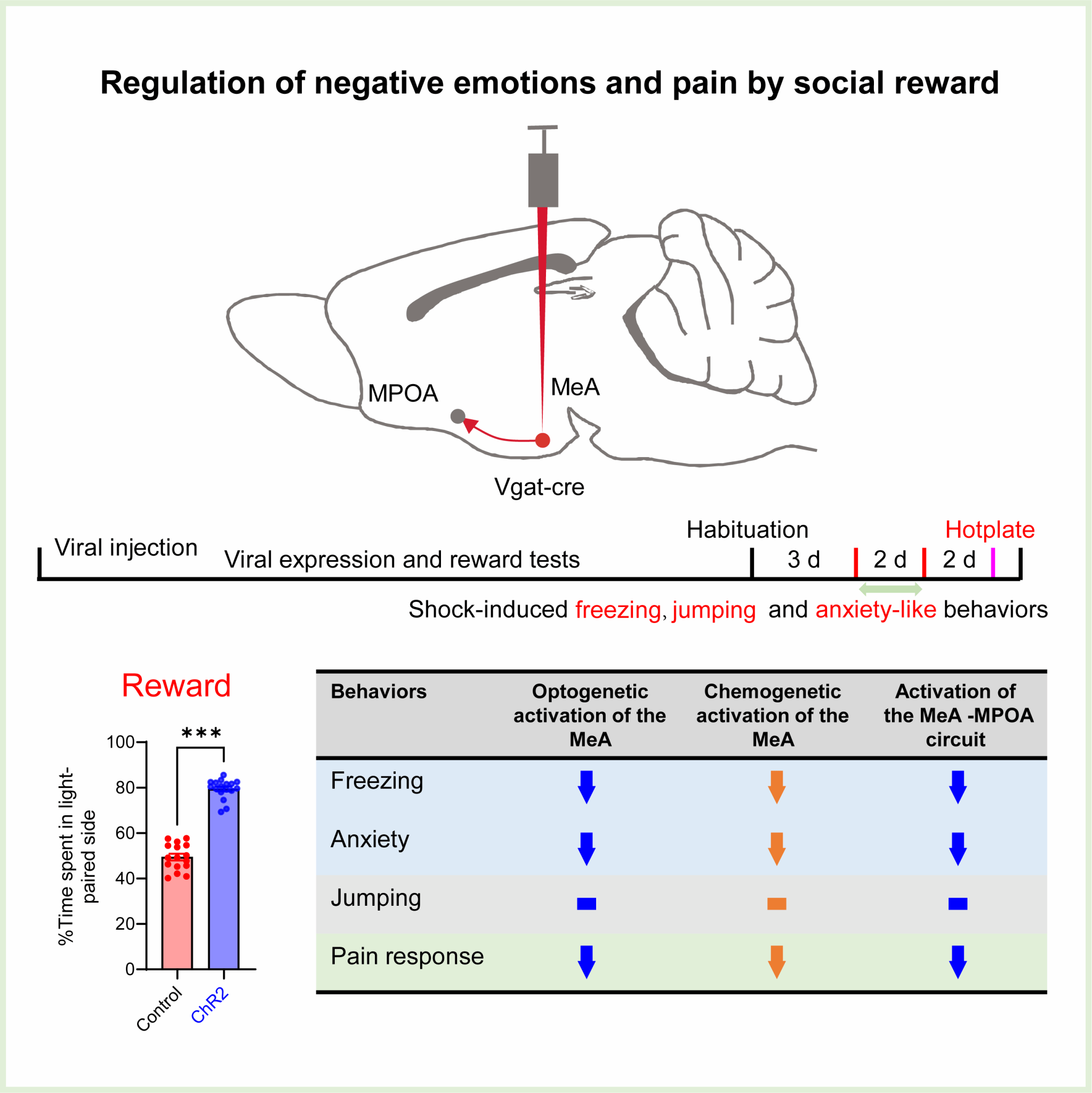
图1. 本论文研究总结
复旦大学/上海市浦东医院胡荣峰研究员和上海交通大学附属上海市精神卫生中心胡帅帅青年研究员为本文通讯作者。复旦大学脑科学转化研究院卢心琪(22级直博生)和陈国华(23级直博生)为该论文的共同第一作者。美国加州大学洛杉矶分校的Weizhe Hong教授也做出了重要贡献。也感谢邓娟研究员提供了技术支持。该论文得到国家自然科学基金项目(No.82301395)等资助。
原文链接
Xinqi Lu, Guohua Chen, Weizhe Hong, Shuaishuai Hu*, Rongfeng K. Hu*. (2025) Alleviation of negative emotional and pain responses through amygdala-hypothalamic social circuit activation. PNAS. 122 (47) e2511106122. https://doi.org/10.1073/pnas.2511106122
参考文献:
1. L. L. Tan, R. Kuner, Neocortical circuits in pain and pain relief. Nat Rev Neurosci 22, 458-471 (2021).
2. C. Peirs, R. P. Seal, Neural circuits for pain: Recent advances and current views. Science 354, 578-584 (2016).
3. E. Navratilova, F. Porreca, Reward and motivation in pain and pain relief. Nat Neurosci 17, 1304-1312 (2014).
4. R. B. Fillingim, Individual differences in pain: understanding the mosaic that makes pain personal. Pain 158, S11-S18 (2017).
5. K. Onoda et al., Decreased ventral anterior cingulate cortex activity is associated with reduced social pain during emotional support. Soc Neurosci-Uk 4, 443-454 (2009).
6. E. L. Miller, Social Connectedness and Pain. Pain Manag Nurs 24, 111-112 (2023).
7. S. F. Allen, S. Gilbody, K. Atkin, C. van der Feltz-Cornelis, The associations between loneliness, social exclusion and pain in the general population: A N=502,528 cross-sectional UK Biobank study. J Psychiatr Res 130, 68-74 (2020).
8. N. Prakash, A. Abu Irqeba, J. G. Corbin, Development and function of the medial amygdala. Trends Neurosci 48, 22-32 (2025).
9. F. Sun, E. Y. Wu, W. Hong, A neural basis for prosocial behavior toward unresponsive individuals. Science 387 (2025).
10. Y. E. Wu et al., Neural control of affiliative touch in prosocial interaction. Nature 599, 262-267 (2021).
11. R. K. Hu et al., An amygdala-to-hypothalamus circuit for social reward. Nat Neurosci 24, 831-842 (2021).
12. D. Ivanova et al., Urocortin3 in the Posterodorsal Medial Amygdala Mediates Stress-induced Suppression of LH Pulsatility in Female Mice. Endocrinology 162 (2021).
13. M. Yoshida, Y. Takayanagi, T. Onaka, The Medial Amygdala-Medullary PrRP-Synthesizing Neuron Pathway Mediates Neuroendocrine Responses to Contextual Conditioned Fear in Male Rodents. Endocrinology 155, 2996-3004 (2014).









 Address:No.138, medical college road
  Postcode:200032
  Tel/Fax:021-54237056
 Emial:itbr@fudan.edu.cn