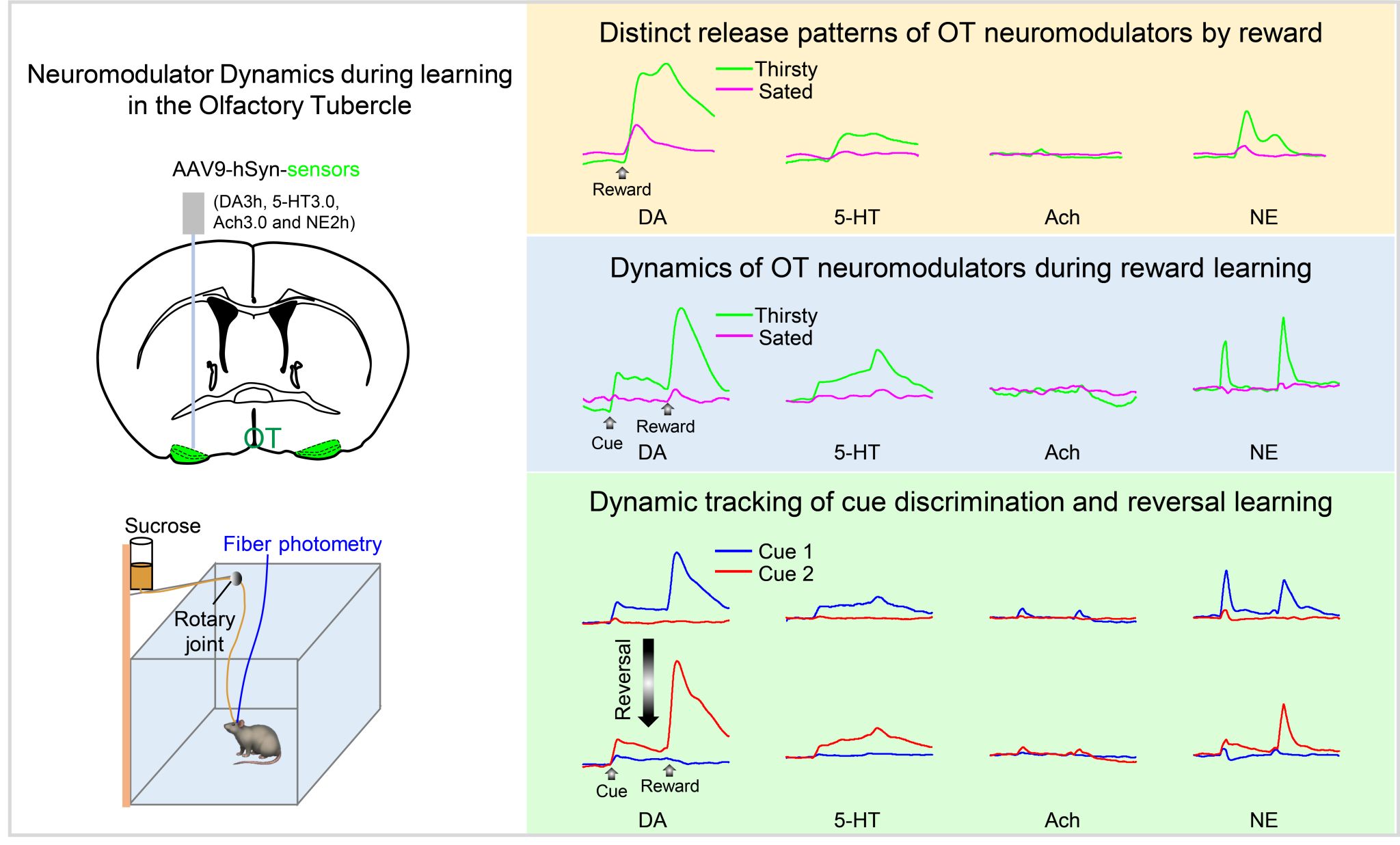
The research titled "Neuromodulator dynamics underlying associative learning in the ventral striatum's olfactory tubercle " was published online in Advanced Science on March 23, 2026. The brain's neuromodulatory systems—particularly dopamine (DA), serotonin (5-HT), acetylcholine (ACh), and norepinephrine (NE)—play a crucial role in reward processing and associative learning. The olfactory tubercle (OT), a region that overlaps with the olfactory cortex and ventral striatum, has been implicated in non-olfactory functions such as learning and motivation. Moreover, it receives dense innervation from multiple neuromodulator-producing brain regions. Yet, how neuromodulator dynamics in the OT encodes external rewards and shapes different forms of associative learning remains unclear. Using fiber photometry and genetically encoded sensors, we captured reward-evoked release patterns of four neuromodulators in the OT and tracked their dynamics across distinct learning processes. We uncover sex-specific, state-dependent, and type-selective response dynamics to external rewards. Moreover, OT neuromodulators encode reward learning and extinction in a sexually dimorphic and state-dependent manner. Notably, unlike the nucleus accumbens (NAc), OT dopamine does not encode reward prediction error. Finally, these neuromodulators dynamically track cue discrimination and reversal learning. Together, we present a systematic framework mapping how OT neuromodulation encodes reward processing and associative learning. This advances our understanding of OT's roles in both healthy cognition and neuropsychiatric disorders, such as addiction and depression.









 Address:No.138, medical college road
  Postcode:200032
  Tel/Fax:021-54237056
 Emial:itbr@fudan.edu.cn