Humans have extraordinarily powerful brains, but what gives them this cognitive edge? A team led by Yousheng Shu at Fudan University, in collaboration with researchers from the Chinese Academy of Sciences, Shanghai Deji Hospital, and Northwestern Polytechnical University, has uncovered new insights by studying a rare type of neuron in the human cortex: spindle neurons (SPNs), also known as von Economo neurons1. Their findings were recently published in Nature Communications under the title “Spindle neurons in human cortex possess distinctive firing properties and transcriptomic signatures”2.
SPNs are found in species with advanced cognition, including humans, elephants, and whales, but are absent in rodents. In humans, they are concentrated in deep layers of the insula and anterior cingulate cortex and are thought to play key roles in higher cognition and social behavior3. They are also particularly vulnerable in conditions such as frontotemporal dementia, Alzheimer’s disease, and autism4,5. Previous studies suggested that SPNs share multiple molecular markers with extratelencephalic-projecting pyramidal cells (ET-PCs), raising the possibility that they belong to the same neuronal class6,7. However, it remained unclear whether SPNs constitute an independent cell type.
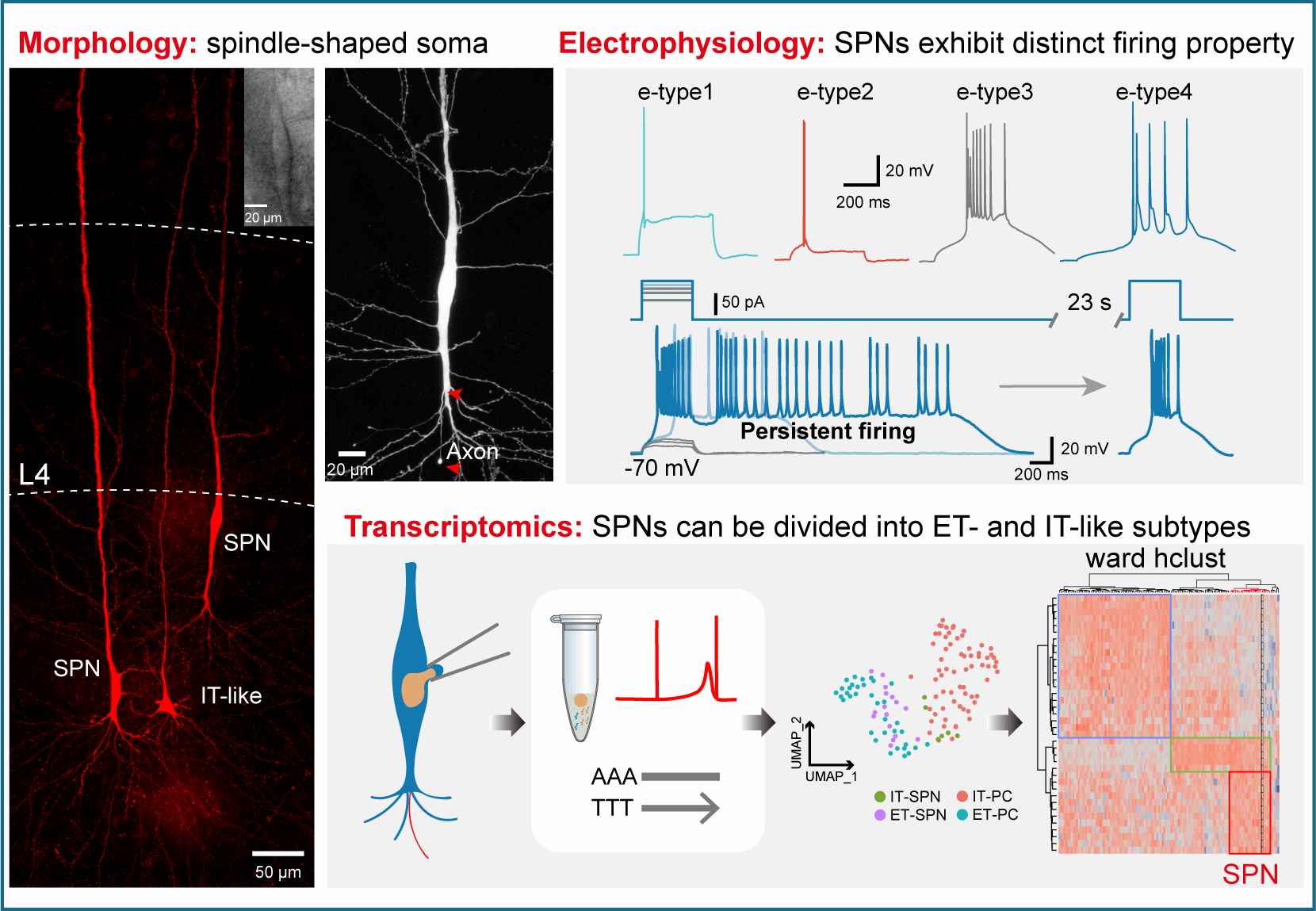
Using human brain tissue obtained during neurosurgery, the researchers combined morphology, electrophysiology, and patch-seq to study SPNs in detail. Key findings include:
1. Distinct morphology: SPNs have spindle-shaped cell bodies and unique dendritic structures, with axons arising mainly from the basal dendrite, suggesting specialized patterns of synaptic integration.
2. Unique electrophysiology: SPNs show high excitability, including burst firing and persistent firing for seconds after brief stimulation, which may support rapid, sustained information processing in the human brain.
3. Molecular fingerprint: While sharing some markers with ET-PCs, SPNs are transcriptomically distinct and can be subdivided into IT-type and ET-type SPNs. A set of 38 “fingerprint” genes specifically identifies SPNs, providing a valuable tool for future research.
This work demonstrates that SPNs are a distinctive neuronal class in the human brain, with internal diversity, specialized firing properties and molecular identity. These findings shed light on the cellular basis of human cognition and offer new avenues to explore neurological disorders where SPNs are affected.
The study was supported by the Changping National Laboratory, the National Natural Science Foundation of China, Shanghai’s Academic Leaders Program, and the China Postdoctoral Science Foundation.
Original article: https://www.nature.com/articles/s41467-026-72935-2
1. Economo, C. V. Eine neue art spezialzellen des lobus cinguli und lobus insulae. Z. f. d. g. Neur. u. Psych.100, 706–712 (1926).
2. Ke, W. et al. Spindle neurons in human cortex possess distinctive firing properties and transcriptomic signatures. Nat Commun https://doi.org/10.1038/s41467-026-72935-2 (2026) doi:10.1038/s41467-026-72935-2.
3. Allman, J. M., Watson, K. K., Tetreault, N. A. & Hakeem, A. Y. Intuition and autism: a possible role for Von Economo neurons. Trends in Cognitive Sciences9, 367–373 (2005).
4. Seeley, W. W. Selective functional, regional, and neuronal vulnerability in frontotemporal dementia. Current Opinion in Neurology21, 701–707 (2008).
5. Pineda, S. S. et al. Single-cell dissection of the human motor and prefrontal cortices in ALS and FTLD. Cell187, 1971-1989.e16 (2024).
6. Yuan, J. et al. Single-nucleus multi-omics analyses reveal cellular and molecular innovations in the anterior cingulate cortex during primate evolution. Cell Genomics4, 100703 (2024).
7. Hodge, R. D. et al. Transcriptomic evidence that von Economo neurons are regionally specialized extratelencephalic-projecting excitatory neurons. Nat Commun11, 1172 (2020).








 Address:No.138, medical college road
  Postcode:200032
  Tel/Fax:021-54237056
 Emial:itbr@fudan.edu.cn